Open to Public & Trade | Visit Our Ormeau HQ: 2/46 Blanck St Ormeau QLD 4208 | Call: (07) 5580 6993 | Weekdays 8 AM – 4 PM | Fast Australia-Wide Shipping | Get a Quote
When it comes to protecting Australian infrastructure, few assets are as hard-working or as frequently misunderstood as the steel bollard. From the high-traffic loading docks of Western Sydney to the coastal promenades of the Gold Coast, these vertical posts are the first line of defence for pedestrians and property.
When selecting steel bollards in Australia, the primary decision drivers are function (Fixed vs. Surface Mounted) and environment (316 Stainless for coastal vs. Galvanised for industrial). Fixed bollards provide the highest impact resistance, while surface mount bollards offer faster installation on existing concrete slabs. Compliance with AS 1428.1 and AS 2890.1 remains mandatory
for all public and car park installations.
However, selecting a steel bollard is not a set and forget task. True compliance and safety require an understanding of material science, substrate integrity, and Australian Standards. This guide provides the technical framework necessary to choose, install, and maintain steel bollards that stand the test of time.
Before diving into the engineering nuances, it is essential to understand the primary configurations of steel bollards used in Australian projects. Selecting the correct steel bollard requires balancing the installation environment with the specific security or traffic management goal.
| Bollard Type | Best For | Impact Profile | Primary Benefit |
|---|---|---|---|
| Fixed In-Ground | New Build / High Security | High Energy Absorption | Maximum structural permanence |
| Surface Mount | Retrofitting / Warehousing | Low to Medium | No core drilling required |
| Removable/Lockable | Emergency/Shared Access | Medium | Flexible perimeter control |
| Pivot / Fold-Down | Private Parking Bays | Low | Authorised vehicle access |
The Australian climate is notoriously harsh, meaning your choice of finish is as critical as the steel bollard itself.
Steel bollards are deployed across diverse industries, each with unique requirements. Shopping centres and retail precincts use them to prevent accidental “pedal error” storefront crashes. Warehouses rely on heavy-duty steel bollards to protect racking and machinery from forklift impact. Meanwhile, local councils utilise bollards to delineate pedestrian zones from roadways, ensuring public safety in busy urban centres.
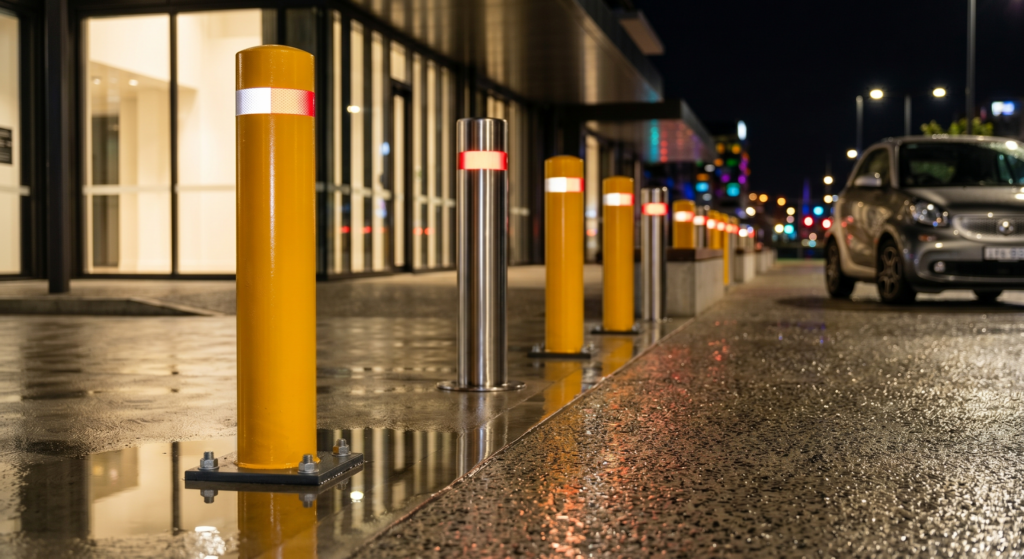
A common mistake in the industry is treating the steel bollard as an isolated component. In reality, a bollard is a system that includes the post, the fixings, and the substrate.
When a surface mount bollard fails under impact, the root cause is rarely the steel itself snapping. Instead, failure typically occurs within the substrate-to-anchor interface. Risk factors include:
Compliance in Australia is governed by strict regulations to ensure accessibility and safety. Failing to meet these standards can lead to significant legal liability and costly retrofitting.
AS 2890.1 dictates the placement of car park bollards to ensure they do not become hazards themselves. Bollards must be placed at specific offsets from walls and parking lines to allow for safe vehicle movement while still protecting assets like fire hydrants or structural columns.
Most competitors focus solely on the sale. However, at Tactile Systems, we believe a steel bollard is a safety asset that requires a lifecycle management plan. Neglecting maintenance can lead to a loss of structural integrity and a breach of safety compliance.
Facility managers should implement a recurring audit that covers the following technical points:
Directly bolting a surface mount bollard into asphalt is generally not recommended for safety applications. Asphalt is a flexible pavement and lacks the tensile strength to hold anchors under impact. For asphalt areas, it is best practice to cast a concrete footing and use an in-ground steel bollard or a cast-in sleeve.
While it depends on the expected impact load, a minimum of 150mm of reinforced concrete is the standard recommendation for industrial car park bollards to ensure anchor retention.
Steel bollards offer a much smaller footprint while providing equivalent or superior stopping power. They are also easier to replace or upgrade without major excavation, especially in the case of surface mount or removable models.
Navigating the complexities of substrate science and Australian Standards can be challenging. Whether you are specifying car park bollards for a new commercial development or auditing the safety of an existing warehouse, the right technical advice is crucial.
Tactile Systems Australia specialises in high-performance accessibility and safety products designed for the Australian built environment. Our team can assist with technical specifications, ensuring your choice of steel bollard meets both your aesthetic requirements and your legal obligations.
By choosing a partner that understands the engineering truth behind every installation, you ensure that your public spaces remain safe, compliant, and durable for years to come. Contact our technical team today to discuss the requirements for your next project.
Open to Public & Trade | Visit Our Ormeau HQ: 2/46 Blanck St Ormeau QLD 4208 | Call: (07) 5580 6993 | Weekdays 8 AM – 4 PM | Fast Australia-Wide Shipping | Get a Quote