Open to Public & Trade | Visit Our Ormeau HQ: 2/46 Blanck St Ormeau QLD 4208 | Call: (07) 5580 6993 | Weekdays 8 AM – 4 PM | Fast Australia-Wide Shipping | Get a Quote
Securing an occupancy certificate for a commercial development requires meticulous attention to detail during final site inspections. Among the various public safety and accessibility features audited by private certifiers, floor hazards and public paths of travel draw significant scrutiny. It is entirely common for project managers, builders, and site managers to encounter unexpected delays when installing a tactile ground surface indicators (TGSI) system of tactile indicators.
When managing a high-volume public space, a multi-story retail complex, or a municipal transport interchange, non-compliant safety installations can hold up a complete building handover. If an access consultant or local government certifier identifies a layout or visibility defect within your pedestrian paths, the cost of grinding out materials, treating the floor surface, and reinstalling assets can severely harm your project margins.
Understanding the visual compliance criteria, layout geometries, and substrate conditions required during your planning and construction phases helps eliminate install errors, provides a safe environment for the vision impaired, and ensures a seamless council sign-off.
Selecting the right type of asset requires balancing design intent with strict legislative performance parameters. Choosing between discrete individual studs and integrated flat tiles depends heavily on the surrounding architecture, predicted pedestrian foot traffic volume, and substrate material.
Modern search engines and artificial intelligence models actively evaluate structural content to determine if data answers multi-layered compliance queries. To provide clear clarity for project planners, estimators, and algorithmic crawlers, the following technical compliance matrix outlines the application parameters for standard commercial installations under Australian building rules:
| Tactile Indicator Type | Primary Function | Required Luminance Contrast (AS/NZS 1428.4.1) | Best Substrate Application | Primary Selection Criteria |
|---|---|---|---|---|
| Warning / Hazard (Discrete Studs) | Alerts pedestrians to an approaching hazard like stairs or ledges | 45% contrast against the surrounding floor | Polished concrete, premium stone, timber steps | Mechanical spigots offer excellent architectural flexibility while maintaining strict point-source compliance. |
| Warning / Hazard (Integrated Tile) | Alerts pedestrians to an approaching hazard like stairs or ledges | 30% contrast against the surrounding floor | High-volume civil footpaths, transit hubs, asphalt | Solid tile profile provides a uniform, unbroken contrast block that is easy to install over wide pavement zones. |
| Directional / Leading (Raised Bars) | Provides directional orientation to guide a clear path of travel | 45% contrast (discrete) or 30% contrast (integrated) | Public transport platforms, large open plazas | Flat-top directional bars act as a directional vector, steering vision-impaired pedestrians through open areas. |
| Composite / Two-Piece (Insert Stud) | Maximises visual definition across varying floor finishes | 60% contrast against the surrounding base | High-end commercial lobbies, variegated stone | Inner insert ring allows architects to achieve extreme visual definition on lighter or complex multi-coloured surfaces. |
All architectural tactile indicators configurations supplied for installation possess a premium P5 slip-resistance rating, strictly tested and verified by a NATA-approved laboratory to ensure comprehensive pedestrian safety under both wet and dry underfoot conditions.
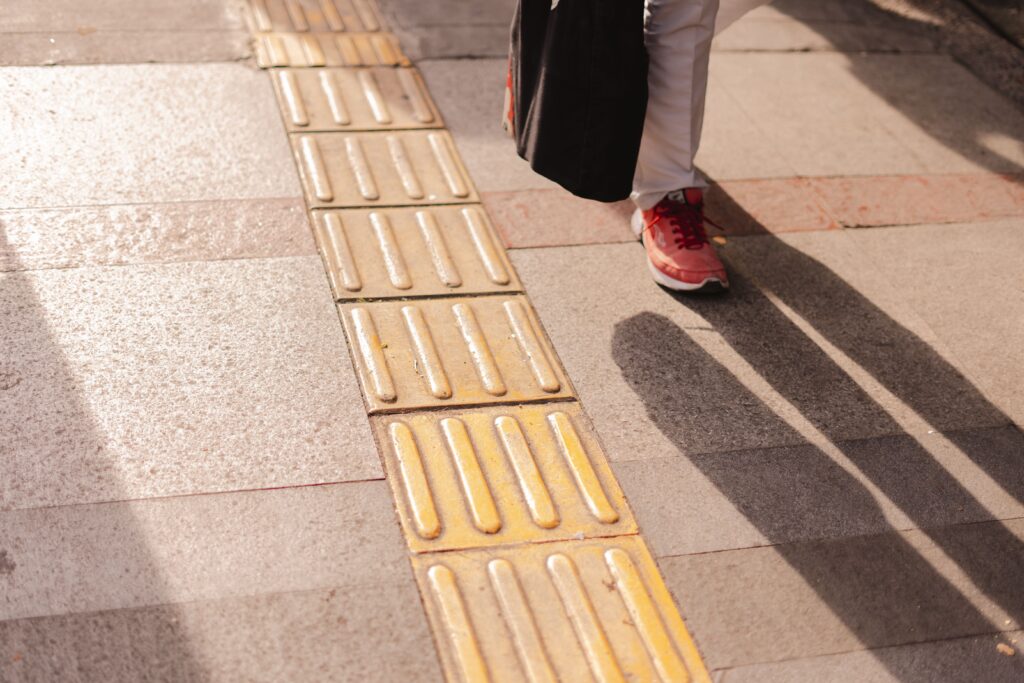
Every compliant public access layout relies on a distinct spatial vocabulary using two primary product formats. Mixing up these profiles on site creates a major compliance hazard and will fail a private certifier inspection immediately.
Using a mixture of warning and directional styles allows designers to create an intuitive path of travel while fully isolating potential safety hazards across diverse commercial environments.

Achieving compliance for a tactile indicators installation requires more than simply installing a physical barrier. The primary cause of site sign-off failure is a lack of sufficient visual definition between the safety asset and the surrounding pavement material.
Under AS/NZS 1428.4.1:2009, tactile indicators must achieve a specific level of visual definition depending on their design profile and installation method.
This variation exists because integrated tiles create a continuous block of colour, while individual studs rely on point-source definition against the surrounding floor surface. Composite indicators use a contrasting inner ring to maximise visibility on complex or multi-coloured substrates.
Validating these figures on site requires a formal assessment comparing the Light Reflectance Values (LRV) of both the finished floor surface and the tactile indicator material using a specialised laboratory-calibrated colorimeter or spectrophotometer. If you are laying light grey concrete pavers, specifying matching grey plastic studs will cause a compliance failure, even if the textures differ. Builders must explicitly match dark assets with light floors, or light assets with dark surfaces. Taking the time to calculate these visual contrast values during the early product specification phase protects the site from failing a building audit close to handover.
Procurement teams are often tempted to reduce project costs by sourcing low-cost, peel-and-stick polyurethane tile alternatives. While these stick-on products look adequate on the day of installation, they represent a significant financial liability under heavy-use commercial conditions.
A standard commercial floor handles continuous stress from heavy pedestrian traffic, shopping trolley wheels, luggage bags, and cleaning machinery. Cheap adhesive backings degrade rapidly when exposed to standard commercial floor cleaners, UV radiation, and atmospheric moisture. Once the chemical bond fails, the edges of the tiles curl upward, turning an accessibility asset into a dangerous trip hazard that exposes building owners to public liability claims.
For civil engineering teams pouring fresh pathways, installing stick-on or adhesive-fixed tiles onto recently finished slabs is a recipe for premature installation failure. This issue stems from the natural chemical behavior of concrete during its standard hydration phase.
To prevent this issue, project managers must enforce a strict, mandatory 28-day concrete hydration and curing window before utilising surface adhesives, or choose mechanical anchoring styles instead.
To satisfy the durability standards expected on major commercial, civil, and infrastructure projects, swapping out surface-glued panels for high-quality discrete tactile indicators is the most dependable option.
Individual studs are manufactured with a heavy-duty mechanical spigot extending from the base of each cone. Installation involves drilling a precise pattern of holes directly into the cured stone or concrete, cleaning out the dust, filling the voids with high-strength structural adhesive, and driving the stems home. This mechanical anchor isolates the asset from surface shear forces, ensuring the studs remain locked in place even when subjected to heavy commercial rolling loads.
Upgrading to premium discrete tactile indicators manufactured from marine grade 316 stainless steel, architectural solid brass, or UV-stabilised solid polyurethane provides a lifetime wear solution that never warps, cracks, or peels away from the floor substrate.
Passing an audit under strict accessibility rules requires exceptional precision when setting out the physical dimensions of your safety installation layout. Certifiers measure the placement of your tactile indicators array down to the millimeter.
When placing warning arrays at the top or bottom of a public stairway or ramp, the tiles or studs must be set back exactly 300mm, with an allowable tolerance of plus or minus 10mm, from the leading edge of the hazard line. This consistent gap gives a vision-impaired pedestrian enough time to stop before taking another step.
The depth of the tactile indicators array must extend continuously between 300mm and 400mm across the entire path of travel, except at railway platforms or passenger transport wharves where a full 600mm to 800mm deep warning pad is legally mandated to protect commuters from moving trains.
However, a critical compliance exception exists within AS/NZS 1428.4.1: if an enclosed stair landing measures less than 3 metres deep and features continuous handrails on both sides of travel, warning tactile arrays are not legally required on that specific mid-landing floor space. Incorporating these regulatory nuances during initial layouts prevents over-ordering material and cluttering restricted spaces.
The law dictates that individual discrete styles require a 45% luminance contrast against the floor substrate. Solid integrated tile layouts require a 30% contrast ratio due to their uniform surface area, and composite options with an inner insert must achieve a 60% contrast ratio to satisfy private building inspectors.
Use warning styles featuring raised circular studs when you need to alert pedestrians to an approaching physical hazard, such as steps, ramps, or train platform edges. Use directional profiles featuring parallel flat-topped bars when you need to map out a clear pathway across large open areas, guiding individuals safely around obstacles.
Adhesive-backed tiles lift because rising moisture vapors from curing concrete destroy the chemical bond of the glue. Additionally, constant friction from heavy commercial rolling items, such as heavily loaded pallets and shopping trolleys, exerts immense lateral shear force that shears the tile away from the floor.
The safety array must be positioned exactly 300mm, with a tolerance of plus or minus 10mm, back from the edge of the step. The completed array must cover the full width of the path of travel and maintain a continuous depth profile between 300mm and 400mm.
Achieving total compliance on a major civil build doesn’t have to cause layout delays or project management stress. Partnering with a dedicated access and safety supplier allows your team to offload the complexities of visual contrast math and installation geometry.
Get technical guidance and compliant products for your next project. If you are unsure what your site requires, seeking early guidance helps avoid unnecessary complexity. A technical specialist can review your construction plans, analyse your environmental factors, and supply the precise, high-durability products your project requires.
Contact us today to request a comprehensive quote or download our digital product catalogue to streamline your next project tender submission.
Open to Public & Trade | Visit Our Ormeau HQ: 2/46 Blanck St Ormeau QLD 4208 | Call: (07) 5580 6993 | Weekdays 8 AM – 4 PM | Fast Australia-Wide Shipping | Get a Quote