Open to Public & Trade | Visit Our Ormeau HQ: 2/46 Blanck St Ormeau QLD 4208 | Call: (07) 5580 6993 | Weekdays 8 AM – 4 PM | Fast Australia-Wide Shipping | Get a Quote
Basement and multi-storey car parks share the same problem: low light, hard edges, and drivers moving through an unfamiliar layout. Reflective tape is one of the cheapest, fastest ways to reduce that risk, but only if you buy the right colour for the job. Get it wrong and you end up with tape that fades within a year or that looks bright in the shop but disappears under real car park lighting.
This guide walks through how reflective and retroreflective tape works, where each colour belongs in a car park or basement, and what to check before you buy.
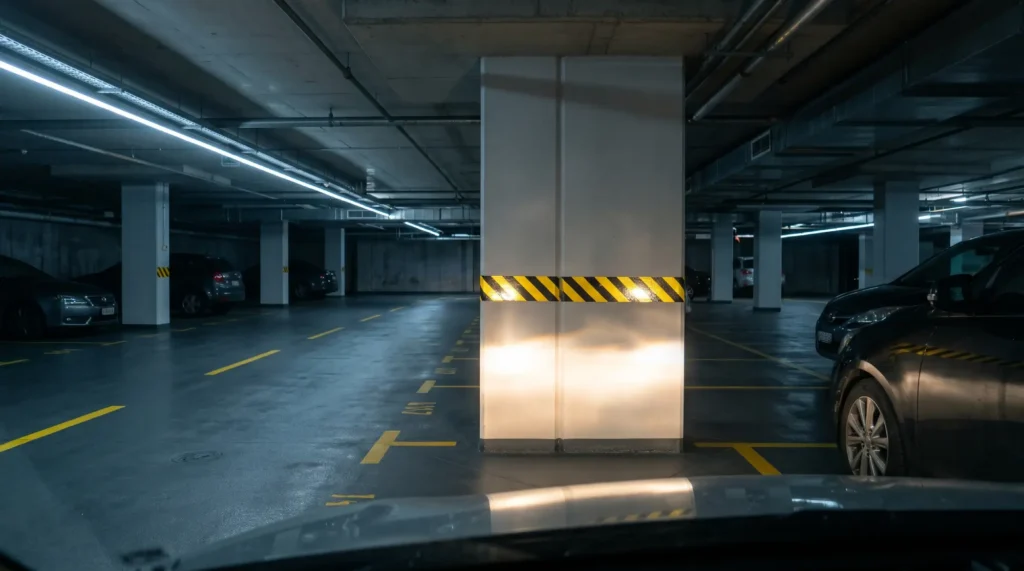
Reflective tape for car parks and basements is chosen mainly on colour. Red is commonly applied to bollards to mark them as a fixed hazard. Black and yellow striped tape is typically used on boom gates and height or clearance bars, where a hazard needs to be unmistakable from a distance. Before you buy, ask your supplier whether the tape is retroreflective (bounces light back at night) rather than just fluorescent (bright in daylight only), and what expected outdoor life it carries.
The terms are often used interchangeably, but there is a practical difference worth knowing before you buy. Reflective tape is a broad term covering any tape designed to stand out under light, including high visibility fluorescent tapes that are bright in daylight but do not necessarily bounce light back strongly at night. Retroreflective tape is engineered to bounce light directly back towards its source, which is what makes a column or kerb edge suddenly light up in a car’s headlights. This is the property that matters most in a basement or car park, where headlights are often the only light source at ground level.
For car park and basement applications, retroreflective tape is generally the better choice over a purely fluorescent high visibility tape, because it is doing its job precisely when natural and ambient light are at their worst.
Tactile Systems currently stocks reflective tape in the following options:
Tactile Systems’ own product photography shows two confirmed placements: red tape applied to bollards, and black/yellow striped tape applied to a height clearance bar at a car park or basement entry point.
Beyond those two, reflective tape is generally used across a wider set of car park fixtures as part of a complete visibility strategy, including structural columns and low beams, where drivers have the least reaction time; the leading edges of wheel stops, so they remain visible after the surrounding line marking has worn; kerbs, ramps and steps at the pedestrian and vehicle interface; and around corner guards, reinforcing the physical protection with visual warning.
Under Australian work health and safety duties, a business has a general obligation to identify and manage foreseeable hazards on a site, and poor visibility of fixed hazards such as bollards, boom gates, columns and low clearances in a basement car park is a foreseeable and easily managed risk. Reflective tape is not a substitute for adequate lighting or line marking design, but it is a low cost, fast to install control that reduces the chance of a vehicle or pedestrian strike, and is widely used alongside bollards, wheel stops and safety railing as part of a broader car park safety fit out.
High visibility tape is generally optimised for daytime visibility using bright fluorescent colours. Retroreflective tape is engineered to bounce light back at night or in low light, which matters more in basements and car parks where headlights are often the main light source.
3M is a well known manufacturer of retroreflective materials, but the more useful comparison for buyers is the expected outdoor life of the tape, since this determines durability regardless of brand.
This depends on the amount of UV and weather exposure, and how much direct vehicle contact the area sees. Ask your supplier for the expected outdoor life of the specific tape you’re buying rather than assuming a figure.
From reflective tape through to wheel stops, bollards and safety railing, Tactile Systems can help you put together a complete, compliant visibility and safety fit out for your car park or basement.
Open to Public & Trade | Visit Our Ormeau HQ: 2/46 Blanck St Ormeau QLD 4208 | Call: (07) 5580 6993 | Weekdays 8 AM – 4 PM | Fast Australia-Wide Shipping | Get a Quote