Open to Public & Trade | Visit Our Ormeau HQ: 2/46 Blanck St Ormeau QLD 4208 | Call: (07) 5580 6993 | Weekdays 8 AM – 4 PM | Fast Australia-Wide Shipping | Get a Quote
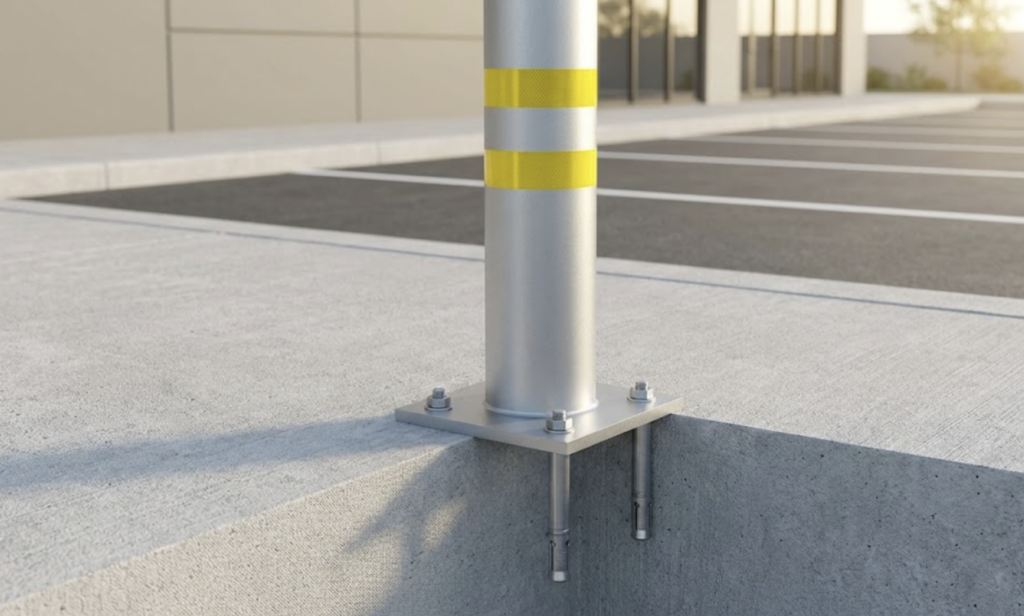
When it comes to rapid asset protection and retrofitting safety measures, the surface mount bollard is the undisputed industry standard. They are faster to install than their in-ground counterparts, require no expensive core drilling, and avoid the nightmare of striking underground utilities. However, there is a common misconception in the Australian construction industry that a bollard is a standalone safety device. In reality, a surface mount bollard is merely one component of a structural system. If that system – comprising the steel post, the base plate, the anchors, and the concrete substrate – isn’t engineered correctly, the bollard becomes nothing more than an expensive visual marker that will fail under the slightest impact.
At Tactile Systems, we believe in providing more than just hardware. We provide certainty. This guide dives into the technical realities that many suppliers gloss over, ensuring your site remains compliant and your assets remain protected.
To understand why some installations fail while others withstand years of heavy-duty use, we must look at the physics of an impact. When a vehicle strikes a surface mount bollard, the energy is transferred from the point of impact, down the steel shaft, through the welded join, and into the base plate. From there, the energy must be dissipated into the concrete slab via the anchors. If any link in this chain is weak, the system fails. Common failure points include:
Choosing a commercial bollard installation requires more than just picking a height; it requires an assessment of the entire environment.
The most frequent cause of bollard failure in Australia isn’t the steel – it’s the ground beneath it. Before specifying a surface mount bollard, you must audit the substrate integrity of your site.
A surface mount bollard is only as strong as the concrete it is bolted to. For standard commercial applications, we recommend:
A common mistake is attempting to install surface mount bollards on asphalt. Bitumen is a flexible, viscous material that softens in the Australian sun. Standard expansion anchors will simply “wiggle” loose over time. If you must install on asphalt, you have two professional options:
The method you use to fix your surface mount bollard to the slab is a critical decision. Not all bolts are created equal.
Mechanical anchors, such as Dynabolts, work by expanding against the sides of the hole as the bolt is tightened. These are excellent for:
In heavy-duty environments like loading docks or busy car parks, vibration from constant traffic can cause mechanical anchors to vibrate loose over time. Chemical anchors involve injecting a high-strength epoxy resin into the hole before inserting the threaded stud.
Providing true site safety means looking at the specific physics of failure. When a surface mount bollard fails, it usually happens in one of two ways.
Many budget-tier bollards use 5mm or 6mm base plates to save on costs. Under impact, these thin plates suffer from “plate curling.” As the bollard is pushed, the plate acts as a lever, prying the bolts straight out of the ground.
Tactile Systems utilizes 10mm to 12mm thick base plates. This thickness ensures the plate remains flat, forcing the anchors to do their job and providing much higher shear strength during a collision.
Even the strongest bolt will fail if it is placed too close to the edge of a concrete slab. This is known as “edge distance.”
Compliance in Australia is about more than just physical strength; it is about legal and safety obligations under the Disability Discrimination Act (DDA) and specific engineering codes.
Bollards are often used to protect pedestrians, but if placed incorrectly, they become hazards for the vision-impaired or those in wheelchairs.
While surface mount bollards are excellent for car parks, they are generally not rated as high-speed crash barriers under AS 3845.1. For high-speed environments or perimeter security against intentional ramming, the choice between core drilling and surface mounting becomes critical. In-ground bollards offer the “earth-coupling” strength required for high-kinetic energy impacts that a surface mount system simply cannot match.
Choosing the right surface mount bollard depends entirely on the intended application.
When choosing materials, consider the environment. The choice between galvanised and 316 stainless steel is based on location. For coastal projects or high-end architectural finishes, 316 stainless steel offers the best corrosion resistance, whereas galvanised steel is the cost-effective workhorse for inland industrial sites.
As highlighted above, it is not recommended for structural protection. For a long-lasting installation, a concrete pad should be poured to provide a stable substrate.
To prevent standard passenger vehicles from passing through while maintaining accessibility, bollards should be spaced between 1.0m and 1.2m apart.
AS 1428.1 focuses on accessibility and ensuring bollards are visible and don’t block paths. AS 3845.1 focuses on the engineering performance of road safety barriers and their ability to redirect or stop vehicles.
Generally, no. In-ground bollards leverage the mass of the earth and a deep concrete footing. Surface mount bollards are limited by the strength of
the existing slab and the anchors.
A surface mount bollard is not a “set and forget” asset. To ensure ongoing asset protection, facility managers should conduct an annual audit:
Surface mount bollards are a versatile and cost-effective solution for Australian businesses, but their effectiveness depends entirely on the quality of the system and the integrity of the installation. By prioritizing base plate thickness, choosing the correct anchoring method, and respecting substrate limits, you ensure your safety investment actually performs when it matters most.
Don’t leave your asset protection to chance. Contact the Tactile Systems specialist team today for a site-specific recommendation or to request technical drawings for your next project.
Open to Public & Trade | Visit Our Ormeau HQ: 2/46 Blanck St Ormeau QLD 4208 | Call: (07) 5580 6993 | Weekdays 8 AM – 4 PM | Fast Australia-Wide Shipping | Get a Quote